
OEM/ODM Scope and Responsibility Splits: A Drugstore Checklist
OEM and ODM are usually explained as who designs the product, but for a drugstore range the more useful reading is who owns each decision. Two projects described as ODM can differ enormously depending on whether the supplier also owns the bottle specification, the artwork, the testing regime and the regulatory file. Scope and responsibility are therefore worth mapping item by item before a model is chosen, because the model name settles far less than buyers assume. A supplier that offers both models should be able to state on a single page which side owns which decision, and that page is the best basis for comparing offers.
Key takeaways
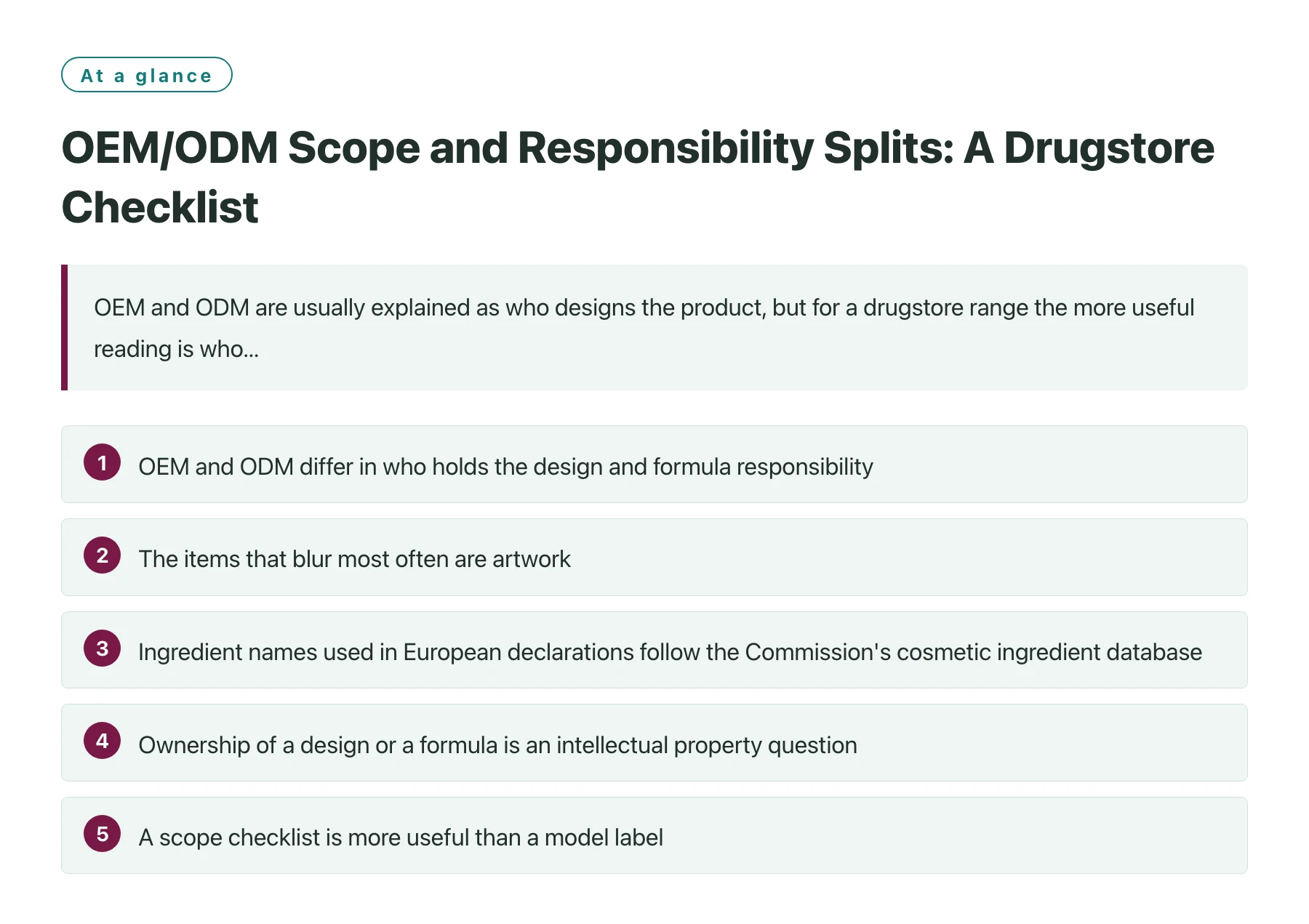
- OEM and ODM differ in who holds the design and formula responsibility, not in who operates the filling line, which is usually the same either way.
- The items that blur most often are artwork, packaging specification, tooling ownership, testing scope and the regulatory file, so each should be assigned in writing.
- Ingredient names used in European declarations follow the Commission's cosmetic ingredient database, which means the naming convention is not a matter of preference [1].
- Ownership of a design or a formula is an intellectual property question, and the terms that govern it should be set out before development work begins [2].
- A scope checklist is more useful than a model label, because it survives changes of supplier, product format and volume.
Ask five suppliers to define ODM and you will get five answers that agree in outline and differ in every detail that matters. The outline is familiar: in OEM the buyer brings the design or the formula and the factory makes it, while in ODM the factory develops the product and the buyer brands it. The details are where drugstore programmes are won and lost, because a retail own-brand range involves packaging, artwork, claims, testing and a documentation set, and each of those can sit on either side of the line. A fragrance house such as Xuelei Xuelei offers both models, which makes the split visible rather than assumed.
The practical consequence is that the model name should be chosen last, after the scope has been mapped. Buyers who start with the label tend to inherit whatever split the supplier prefers, and that split is rarely the one that suits a retailer's requirements. Buyers who start with the checklist usually find that their project is a hybrid: ODM for the scent, OEM for the pack, or the reverse, with the buyer owning the claims and the supplier owning the technical file.
This article sets out the items worth assigning, then looks at where responsibility tends to blur in practice. The drugstore context runs through it, because retail own-brand work has requirements that a standalone fragrance brand may never meet.
What the two models actually change
In OEM work the buyer's decisions arrive as a specification. The factory's job is to reproduce it consistently, which means the buyer carries the risk attached to the design and the factory carries the risk attached to production. In ODM work the supplier develops the product, so the development risk moves to the supplier while the brand risk, meaning claims, positioning and pricing, stays with the buyer.
That division has a second-order effect on speed. ODM projects often start faster because the supplier is working from its own library and its own design language, which is why retail own-brand programmes frequently begin that way, and why custom fragrance R&D and production custom fragrance R&D and production is often bought as a single package. OEM projects can take longer at the front and produce something more distinctive, which matters when a retailer wants a range that cannot be compared directly with a competitor's.
Neither model is superior, and most ranges mix them. The important discipline is to keep the split visible at the level of individual items, because that is where a project either stays inside one management system or acquires a seam.
The sentence that causes most disputes
Disputes rarely come from the model choice itself. They come from a scope paragraph that says the supplier will handle development and production, without saying which party owns the bottle specification, who approves artwork, who commissions testing and who holds the regulatory file. Each of those is a small decision until a problem arrives, at which point it becomes the only decision that matters.
The scope checklist, item by item
| Item | Usually OEM | Usually ODM | Where responsibility blurs |
|---|---|---|---|
| Scent concept and formula | Buyer supplies or commissions the formula | Supplier develops from its library or a bespoke brief | Who owns the composition and what rights the buyer receives [2] |
| Bottle and component specification | Buyer specifies, supplier sources or receives | Supplier proposes from existing tooling | Tooling ownership and who pays for a change of specification |
| Artwork and label content | Buyer owns artwork; supplier supplies data | Supplier may produce artwork from brand assets | Who confirms that the label content matches the formula and the destination market |
| Testing and inspection | Buyer may commission independently | Supplier runs its own package | Whether the scope is named, who pays for repeats, and whether a third party is involved |
| Regulatory and product file | Buyer assembles, supplier provides inputs | Supplier often assembles the technical inputs | Who holds the file, who updates it, and who answers a regulator or a retailer's questions |
| Claims and positioning | Buyer owns entirely | Buyer owns, but may rely on supplier evidence | Whether the evidence behind a claim is documented and transferable |
| Minimum order and reorder terms | Often shaped by the buyer's component volumes | Often set by the supplier's library and tooling | What changes on the second order and how long the price holds |
| Exclusivity | Commonly requested by the buyer | Depends on the supplier's library rules | The field, territory and duration of the restriction |
Filling out that table takes an hour with each supplier and produces something more useful than a quotation: a shared understanding of who does what. It also makes the comparison honest, because two ODM offers that look similar on price can differ on four rows of this table without either supplier intending to mislead.
Where drugstore ranges differ from a standalone brand
A retail own-brand range brings the retailer's own requirements into the scope. The label may need to carry statements the retailer specifies, the artwork may have to follow a template, and the range may be sold in several markets with different language and notification rules. Those requirements have to land on one side of the split, and if they land nowhere the buyer will discover it at the artwork stage.
Replenishment adds a second layer. Because the range is bought repeatedly, the retained reference and the substitution rule matter more than they would for a single launch. A useful question for both models is what happens when a component is discontinued: who decides the replacement, who compares it against the reference, and who signs off the change. That answer belongs in the checklist rather than in a conversation.
Choosing between the models for a first range
A first drugstore range is often best served by an ODM structure for the scent and an OEM structure for the pack, which keeps development fast while preserving the buyer's control over the part shoppers actually see. Buyers who intend to build a distinctive house style should expect to move more items into their own column over time, which is easier when the split has been documented from the start.
The most reliable way to choose a model is to ask the supplier to complete the scope checklist twice, once as OEM and once as ODM, and then compare the two columns. The exercise exposes which parts of the work the supplier genuinely wants to own and which it is willing to hand over, and it usually reveals whether private label fragrance production is being offered as a standard programme or assembled case by case. It also helps to understand the company behind the factory the company behind the factory, because a supplier with its own development and production functions will complete both columns differently from one that coordinates partners.
Sources
- EU CosIng — Cosmetic Ingredient Database (European Commission) —— The European Commission's CosIng database of cosmetic ingredients, listing ingredient functions, restrictions and labelling requirements under EU cosmetics law.
- WIPO — World Intellectual Property Organization —— The UN agency for intellectual property; resources on industrial design and patent protection relevant to product and packaging design.
Frequently asked questions
What is the difference between OEM, ODM and private label?
OEM and ODM describe who owns development: the buyer in OEM, the supplier in ODM. Private label generally describes the commercial arrangement in which a product is sold under the retailer's or brand's own name, and it can be fulfilled through either an OEM or an ODM structure.
Which model is faster for a first drugstore range?
ODM is usually faster to first order because the supplier can work from existing development and tooling. The advantage narrows if the range needs distinctive packaging or claims that require new evidence, since those items often sit with the buyer in both models.
Who should own the regulatory file in an ODM project?
That depends on who is placing the product on the market and in which country. The practical rule is to decide explicitly: one party should hold the current file, know who updates it, and be able to answer a retailer's or a regulator's questions without reconstructing it from emails.
How should tooling ownership be handled?
Tooling should be listed separately from the unit price, with the owner named and the conditions for transferring or reusing it described. Buyers who assume that paying for tooling means owning it sometimes find the opposite in a supplier's standard terms.
Can a range use both models at once?
Yes, and it is common. A scent may be developed under an ODM arrangement while the packaging and artwork are handled under an OEM arrangement. The important point is that each item in the scope is assigned to one side rather than left to be interpreted later.
If the page isn't converting, the copy probably isn't either.
Book a Copy Audit Call. We'll diagnose the leak and quote the rewrite on the spot.
Book a Copy Audit Call