
Two Fees, One Bill: The 2,024 TH/s Worksheet
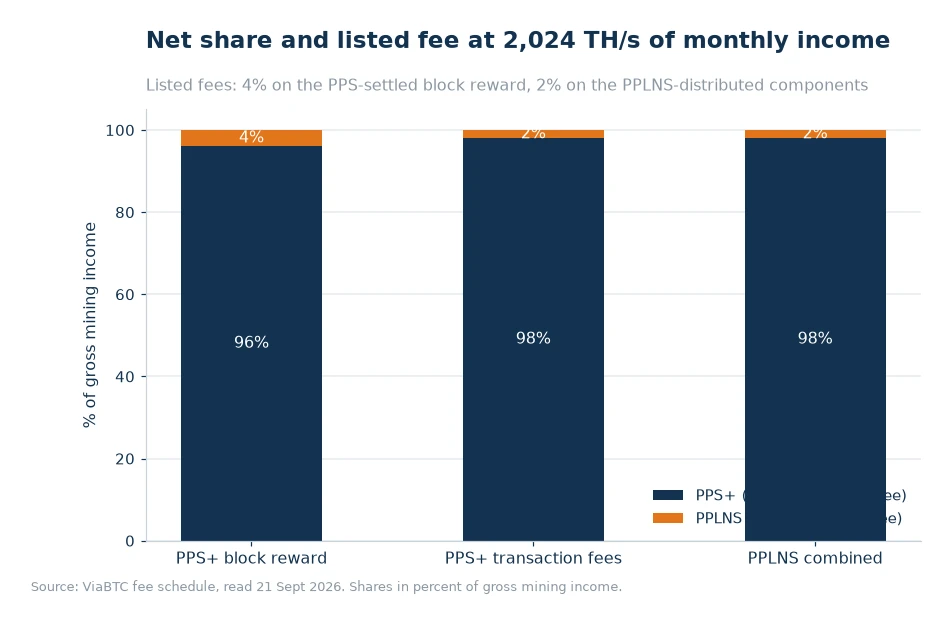
A fee schedule is a set of rates waiting for a base to multiply. At 2,024 TH/s the base is $76.90 a day at $84,692, and the listed 4% on the block-reward component takes $3.08 of it while the listed 2% on the PPLNS-distributed components would take $1.54. The worksheet below puts both on the same page so the comparison stops being abstract.

Key takeaways
- One rate alone cannot describe a PPS+ bill: the listed 4% applies to the block reward and the listed 2% to the fee component.
- At 2,024 TH/s, gross is $76.90 a day, so those rates are worth $3.08 and $1.54 respectively.
- Over 30 days the same rates come to $92.28 and $46.14, against $2,307.00 of gross income.
- PPLNS applies the listed 2% to both components combined, so its single rate covers a wider base.
A rate needs a base before it means anything
Percentages are the easiest part of a fee schedule to quote and the hardest to compare, because two schedules can name the same number and charge different amounts. The difference sits in the base. A rate applied to a subsidy that is paid whatever happens is not the same as a rate applied to fee income that depends on which blocks the pool found.
So the useful question is never "what is the fee" but "what is the fee on, and when is that base settled". Under PPS+, the answer differs by component: the subsidy base is settled hourly against current difficulty, while the transaction-fee base follows a PPLNS distribution. That is why the schedule carries two numbers rather than one.
A worked comparison makes the point faster than a definition. Take a day that earns exactly $100 before fees. If all of it were subsidy, the listed 4% takes $4. If all of it were transaction fees, the listed 2% takes $2. A real day sits between those two and the split decides which rate does most of the work.
The monthly view at 2,024 TH/s
The table shows each rate applied to the full daily gross, which is the largest base it could face. Real bills split the base between subsidy and fees, so the true deduction sits between the rows rather than exactly on one of them.
| What is charged | Listed rate | Per day | Per 30 days | Net per day |
|---|---|---|---|---|
| Block reward under PPS+ | 4% | $3.08 | $92.28 | $73.82 |
| Transaction fees under PPS+ | 2% | $1.54 | $46.14 | $75.36 |
| Both components under PPLNS | 2% | $1.54 | $46.14 | $75.36 |
| Withdrawal of mined coins | 0% | $0.00 | $0.00 | $76.90 |
Read the third column as a ceiling rather than a forecast. A day in which subsidy is most of the income lands nearer the top row, because that is the pile carrying the listed 4%. A day with unusually heavy fee income shifts the mix toward the second row, and those two rows are the ones that actually combine in a PPS+ payout.
Worked example
Four steps from the network totals to the two fee figures.
- Network output: 3.125 BTC × 144 blocks = 450 BTC a day.
- BTC per TH/s: 450 ÷ 1,003,107,267 = 0.00000044861.
- 2,024 TH/s: 2,024 × 0.00000044861 = 0.00090798 BTC.
- Gross value: 0.00090798 × 84,692 = $76.90.
- Block-reward rate: 76.90 × 0.04 = $3.08, leaving $73.82.
- PPLNS rate: 76.90 × 0.02 = $1.54, leaving $75.36.
- Thirty days: 76.90 × 30 = $2,307.00 gross, with $92.28 and $46.14 on the two bases.
- One percentage point at this size: 76.90 × 0.01 = $0.77 a day, or $23.07 a month.
Why the fee component carries the lower rate
The transaction-fee pile is not paid at a fixed rate per share. It is distributed the PPLNS way, which means the miner's slice depends on how much hashrate was contributed across the last two difficulty windows. That arrangement leaves part of the timing risk with the miner, and the listed rate on it is lower as a result.
The subsidy pile is the opposite. It is settled per share at a fixed rate, so the pool absorbs the variance of an unlucky stretch. A schedule that charged the same rate on both would be pricing two different products identically, and one of them would be mispriced. Whether the listed numbers are attractive is a separate question from whether they are structured sensibly.
The mechanics behind the rates are worth knowing for a different reason: they set the rhythm of the account. An hourly credit under PPS+ produces twenty-four entries a day, which is easy to reconcile and easy to alert on. A PPLNS payout arrives when blocks confirm, so a quiet night produces nothing and a busy one produces several entries. Neither pattern is evidence of a problem, but a monitoring routine built for one will misread the other.
Reading the schedule before you commit
The ViaBTC Pool Fees page names both rates and the component each applies to, which is the detail to check first. Then confirm the payout mechanics: PPS+ settles hourly against current difficulty, PPLNS settles after 6 confirmations and spreads the miner's slice over the last 5 difficulty rounds. A schedule without those mechanics beside it is only half a description.
Where the coins land matters too. Credited balances sit in the account's multi-currency wallet, and mining payouts carry no withdrawal fee, so the deduction you calculated is the deduction you keep. If a plan involves moving coins into another asset, the Auto Conversion feature does that inside the same account rather than at an exchange desk.
What the difference buys
A dollar and fifty-four cents a day separates the two rows at 2,024 TH/s, which is $46.14 a month. No operator chooses a payout mode for that sum alone. The reason to understand the split is that it explains the variance each mode carries, and variance at this size is measured in hundreds of dollars a month rather than in a dollar or two a day.
That is also the honest limit of fee comparison. Two pools a percentage point apart are close enough that uptime, payout reliability and the withdrawal terms decide more than the rate does. A pool that pays on schedule at a slightly higher rate usually beats a cheaper one that makes you chase a missing credit.
A day of downtime at this hashrate costs $76.90 gross, which is roughly 50 days of the difference between the two rows. That comparison is the reason uptime deserves a line in the worksheet beside the rates. On paper the fee is the precise number and the uptime figure is a guess, but the guess moves the total further.
Frequently asked questions
Why are there two rates on a PPS+ payout?
Because the payout has two components: the listed 4% applies to the block reward settled per share, and the listed 2% to the transaction-fee part distributed under PPLNS logic.
What does a 30-day month cost at 2,024 TH/s?
Gross income of $2,307.00, from which the listed 4% would be $92.28 on the block-reward base and the listed 2% would be $46.14.
Does PPLNS charge both rates?
No. PPLNS applies the listed 2% to the block reward and transaction fees combined, and it settles after 6 confirmations across the last 5 difficulty rounds.
Do the arithmetic once, then watch the credits
Write the gross day, multiply by each rate, and keep the two results next to the power calculation. At 2,024 TH/s that is $3.08 and $1.54, and neither number should surprise you when the credit history is summed at the end of a month. The Profit Calculator will reproduce the gross figure at current difficulty if you would rather not repeat the division by hand.
After that, the useful habit is a monthly check rather than a daily one. Fees do not drift; hashrate does.
Sources: the ViaBTC pricing, wallet and calculator pages for listed rates and account features[1]. Inputs read 21 Sept 2026: 1,003 EH/s, 132.76 T, 3.125 BTC per block, 144 blocks a day, BTC $84,692. Published 22 Oct 2026; values assume a flat difficulty and full uptime.